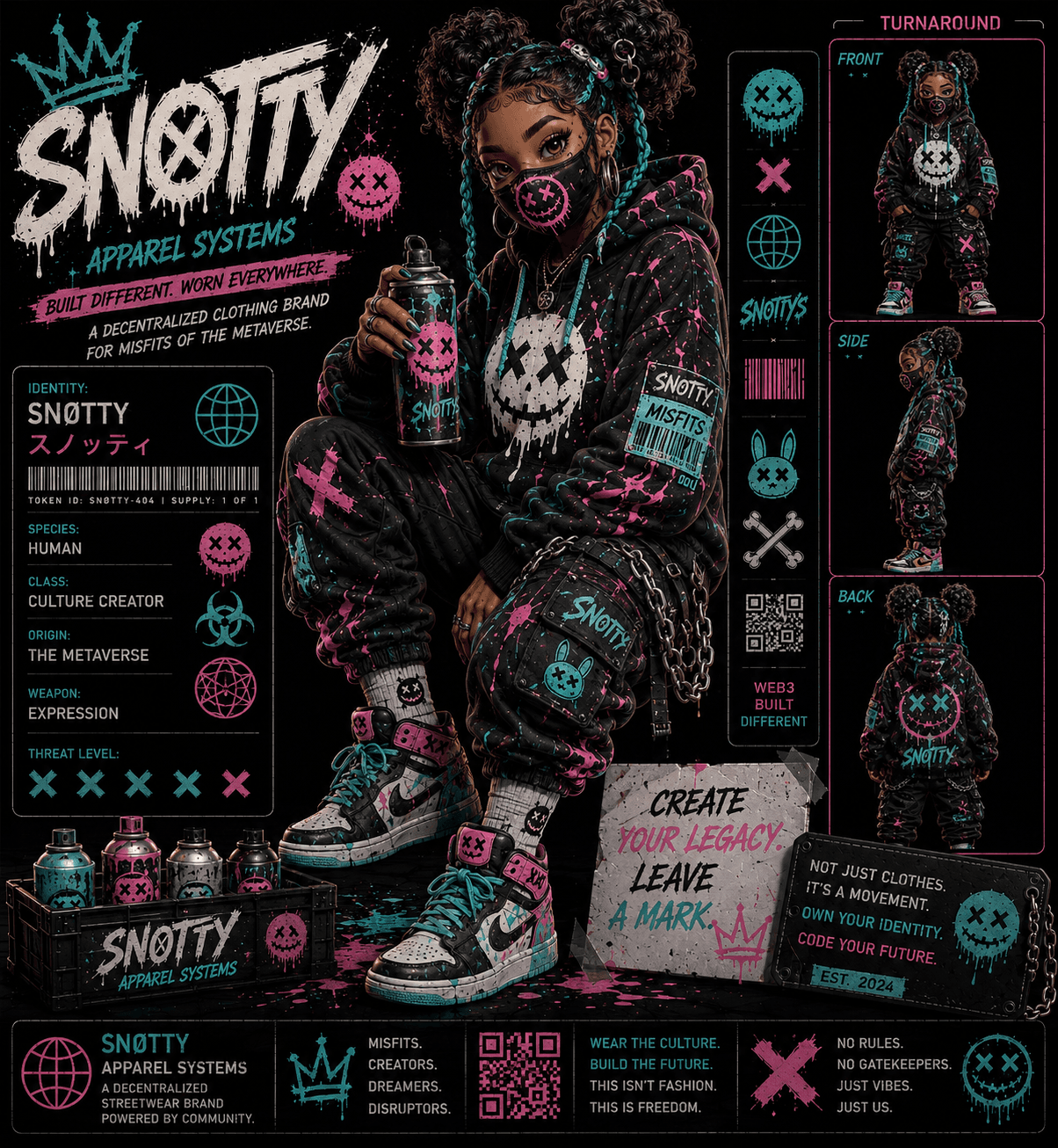
from the factory files
Threads of the Underground
The only human in the crew found the door behind a laundromat. She knocked.
Every city has doors that aren't on the blueprints. The one behind the Wash-N-Go on the corner of Neon Alley has been there longer than the laundromat, longer than the alley, possibly longer than doors. It has no handle, no hinges, and no patience for people who don't belong — hundreds have leaned against it waiting for their delicates and felt nothing but wall.
Threads was sixteen when she felt it hum.
She'd been sketching in the laundromat — she was always sketching, filling books with clothes that didn't exist yet for people the fashion industry pretended didn't exist at all — when the dryer against the back wall finished its cycle, and in the sudden quiet, the wall behind it buzzed. Once. Like a doorbell in reverse. Like something asking.
Here's what makes Threads Threads, and the crew tells this part with reverence: she didn't push the door. She didn't pry at it or film it for followers. She packed up her pencils, walked over, and KNOCKED — politely, three times, the way you knock when you're the guest. Then she sat down on a folding chair and waited, sketching, for four hours.
The door opened at exactly midnight. Filling the entire frame, spikes first, stood Grimm.
Grimm's job at the door is simple: nothing gets in. In the factory's whole history, his record was perfect. He looked down at the human — small, unarmed, radiating the specific calm of a person who has already decided not to be scared — and did the growl. The Growl has turned away process servers, urban explorers, and one entire film crew. Threads, who had been raised by a grandmother and was therefore immune to intimidation as a genre, responded by holding up her sketchbook. 'I don't want in,' she said. 'I want to know if I'm drawing it right.'
The page showed a hoodie. But drawn the way the factory would draw it — drip running true, seams celebrated instead of hidden, a dead-eyed smiley that somehow looked like it was keeping a secret and keeping it FOR you, not from you. Grimm looked at it for a long time. Witnesses (there were no witnesses; the crew has constructed this scene entirely from Grimm's refusals to discuss it) say his collar spikes lowered, one by one, like hackles coming down.
He forgot to growl. He took the sketchbook. He left her on the chair for ten minutes and came back with it — and on the facing page, in paint that hadn't dried and a hand nobody's ever matched, someone inside had written: 'THE SLEEVES ARE WRONG. COME FIX THEM.'
The sleeves were not wrong. Everyone agrees now the sleeves were fine. It was, as far as anyone can tell, the only excuse the handwriting could think of.
What Threads became is harder to title, which is why her tag just says CULTURE CREATOR. She's the bridge — the one who fits monster-made clothes to human bodies, who tells Vandal when a print reads different in daylight, who walks the drops through the city up top where the crew can't easily follow. She runs the lookbooks. She approves the fits. She is the reason Snotty's hangs correctly on ten thousand strangers who will never know there was a door behind their laundromat, and never know how close their hoodie came to having different sleeves.
She still knocks, every time. The door opens before the third knock now — always has, since the first night. She's the only one it does that for, and Grimm, who guards it, and who has opinions about protocol, has never once objected.
Her first sketchbook hangs in the Boiler Room, open to the hoodie page, next to the rules. Under it, in her own handwriting this time, the line she gives every interviewer up top who asks what a human is doing in a monster brand:
"Create your legacy. Leave a mark. Mine just happens to have stitches."
wear the story
Take the Snottyverse home
Every character in the files lives on a shirt, a hoodie, or a wall. Grab yours before the drop's gone.
Shop the collection